
Giving Meaning to Agility with Evidence-Based Management

Agile frameworks, such as Scrum and Kanban, are well-known for helping teams focus more effectively on creating value and adapting to changes more easily. However, agility doesn't stop at the team level. Some approaches also address decision-makers and organizations. Evidence-Based Management is one such approach, offering a different perspective with its structured value and progress management based on concrete evidence.
This article is the third in a series about agility in business. The first two articles covered the Cargo Cult and Scrum principles.
Scrum, Kanban, SAFe... You've probably heard of these agile frameworks and methods designed to help teams organize better, deliver more frequently, and adapt to change.
But as we saw in my article on Agile principles, agility is not limited to team work management. There are also approaches intended for decision-makers and organizations as a whole, to steer the evolution of a product, service, or portfolio of initiatives in a structured, measured way that is aligned with value.
Among these approaches, Evidence-Based Management (EBM) stands out. Proposed by Ken Schwaber, one of the initiators of the Scrum framework, EBM encourages decision-making based on factual data while aligning with Agile principles. Less well-known than team frameworks, EBM is aimed at organizations seeking to progress amid uncertainty while maintaining a clear focus on delivering useful, measurable, and sustainable value.
What is Evidence-Based Management?
Evidence-Based Management is an agile strategic management approach that relies on regularly evaluating the value produced and the organization's ability to adapt, innovate, and satisfy its users.
Rather than relying on rigid plans or long-term predictions, EBM encourages observing reality through tangible data, testing hypotheses, and continuously adjusting strategy based on what truly works.
EBM is therefore not a product development framework or a project management method, but rather a continuous management model compatible with any organization looking to gain agility.
What is its practical purpose?
EBM helps organizations answer essential strategic questions such as:
Are we delivering real value to our users?
Is our organization capable of reacting quickly to changes?
Are our initiatives moving us closer to our long-term objectives?
What obstacles are currently hindering our overall performance?
EBM provides visibility into progress at all levels to encourage smart trade-offs and investments.
A Structured Model with Four Dimensions
EBM is based on 4 key domains for measuring the performance and resilience of an agile organization:
Current Value
** What value does the product or service provide to customers, users, and the organization itself?
Unrealized Value
** What additional value could be achieved by better meeting needs or accessing a new market?
Ability to Innovate
** To what extent is the organization capable of delivering new ideas, solutions, or features?
Time to Market
** What is our capacity to quickly transform an idea into delivered value?
These 4 axes make it possible to visualize the dynamics of continuous improvement. A high-performing organization is one that not only delivers quickly, but also innovates, maximizes produced value, and identifies growth opportunities.
To visualize the entire EBM framework and its interactions, Scrum.org offers this summary diagram:
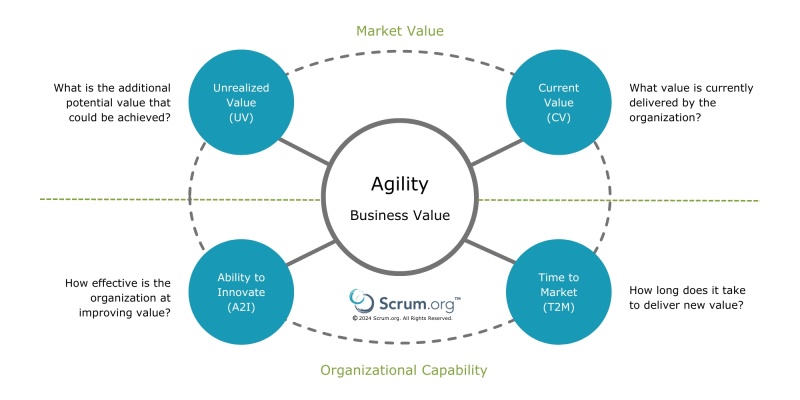 Source: Scrum.org
This diagram presents:
the 4 Key Value Areas (in blue),
examples of associated metrics/indicators (in light grey),
the interactions between the domains
It clearly shows that EBM is an iterative, not linear, process. Progress in one domain (such as the ability to innovate) can unlock new opportunities for value creation or reduce time to market, positively impacting current value.
This framework therefore helps to nurture a data-driven continuous improvement loop at all levels of the organization.
Which Tools and Indicators Should Be Used?
While EBM does not impose unique indicators, it does suggest measures that are consistent with each domain. For example:
For Current Value, use customer satisfaction, market share, retention rate.
For Unrealized Value, consider growth potential, new addressable segments, unexploited feedback.
For Ability to Innovate, look at failure rate of experiments, number of concrete ideas, organizational obstacles.
For Time to Market, the indicators are cycle time, lead time, and deployment frequency.
The important thing is not to measure everything, but to choose relevant indicators to inform decisions. The data must remain useful, accessible, and focus on observable trends, not isolated figures.
How Does EBM Integrate with Scrum or an Agile Approach?
EBM does not replace Scrum or Agile practices; it complements them. EBM is a framework designed to encourage critical thinking among Product Owners, managers, and organizational leaders.
In a Scrum context, the Product Owner can use EBM metrics to adjust the product strategy.
Business leaders can use EBM as a governance tool to evaluate the results of an agile transformation.
Agile teams can draw inspiration from the EBM vision to understand the impact of their work beyond simple deliveries.
Thus, EBM connects strategic decisions to concrete results and fosters a culture of informed experimentation.
In What Contexts is EBM Particularly Useful?
Evidence-Based Management is suitable for organizations that:
are undergoing agile transformation and want to avoid a purely mechanical approach
develop products or services in an uncertain environment
seek to better align strategy with operational reality
or want to transition from an output logic (quantity delivered) towards an impact logic (value created)
To Summarize
Evidence-Based Management (EBM) offers a simple and structured framework for guiding continuous improvement in agile organizations. Using factual data, EBM enables you to measure real value, identify improvement opportunities, and encourage more informed decision-making at all levels.
EBM does not replace Scrum or Kanban; rather, it gives meaning to agile practices and better guides strategic choices by focusing on what truly matters: creating sustainable value for users.