PHP 8.6: JSON Decode Error Position

· Oskar Stark · Expertise · 1 minute to read
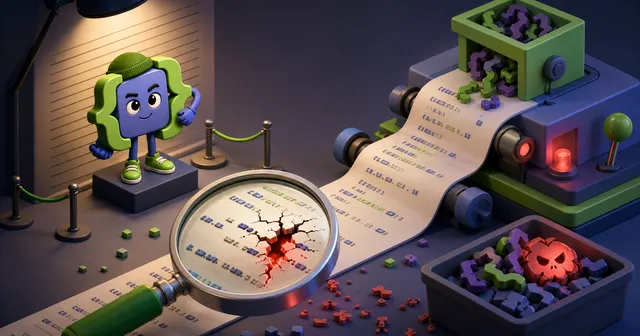
Abstract editorial illustration of PHP 8.6 JSON parsing with a highlighted error position and subtle purple accents

PHP 8.6 adds a small but useful improvement to JSON decoding: you can now get the exact error position when parsing fails. That makes debugging malformed payloads much faster.

A small but practical JSON improvement

When json_decode() fails, PHP has long told you that something went wrong — but not where in the input the problem occurred. With PHP 8.6, that changes: you can retrieve the error position for failed JSON decoding and pinpoint malformed payloads more quickly.

This is especially helpful when you work with API payloads, webhooks, or configuration files where a single missing quote or comma can break the whole document.

Before and after

Before PHP 8.6, you typically had to inspect the raw JSON manually or log the payload and hunt for the issue yourself:

$json = '{"name": "Alice", "age": 30,}';

data = json_decode($json, true);

if ($data === null && json_last_error() !== JSON_ERROR_NONE) {
    echo json_last_error_msg();
}

The message tells you there is a syntax error, but not where it happened.

With PHP 8.6, you can also ask for the error position and use it to locate the problem faster:

$json = '{"name": "Alice", "age": 30,}';

$data = json_decode($json, true);

if ($data === null && json_last_error() !== JSON_ERROR_NONE) {
    echo json_last_error_msg() . PHP_EOL;
    echo 'Error position: ' . json_last_error_pos();
    // Syntax error
    // Error position: 28
}

That position can be used to inspect the surrounding characters in the payload and spot the mistake immediately.

Why it matters

This is not a headline feature, but it is the kind of improvement that pays off in day-to-day debugging:

  • faster diagnosis of malformed JSON

  • less time spent searching through large payloads

  • better logging and observability in API integrations

If your application processes external JSON regularly, this small addition can save a surprising amount of time.


Sources

Need help with PHP upgrades?

If you are planning a PHP version upgrade or want to make your Symfony and PHP applications easier to maintain, SensioLabs can help with reviews, workshops, and practical support.

This might also interest you

Large tree under the sunlight
Mathieu Santostefano

Multiply your AI development speed using Git Worktrees

Say goodbye to context switching and the "stash-and-switch" headache. By leveraging Git Worktrees alongside modern AI agents, you can now isolate environments and handle bug fixes in parallel while your AI builds features in the background. It’s a total DX game-changer that turns your Git workflow into a multi-threaded powerhouse.

Read more : Multiply your AI development speed using Git Worktrees
A man sculpting a rock with PDF written on it
Steven Renaux

Create a Custom Builder - A GotenbergBundle Story

In a previous article, we explored how to generate your first PDF in a few lines of code using Gotenberg and GotenbergBundle, a Symfony bundle that wraps Gotenberg's HTTP API to convert HTML or Office files into PDFs. That was a great start. But what happens when your application needs to generate multiple different PDFs, each with its own layout, styles, data?

Read more : Create a Custom Builder - A GotenbergBundle Story
Paper notes on a wall
Imen Ezzine

Behind the Scenes: 3 Collaborative Ceremonies for Better Development

Following a recent LinkedIn post, I wanted to write this article to describe 3 ceremonies that truly made an impact on me during one of my latest missions: Event Storming, Example Mapping, and Domain Storytelling.

Read more : Behind the Scenes: 3 Collaborative Ceremonies for Better Development
Why PHP?
Silas Joisten

Why PHP Powers the Enterprise Web: The Strategic Advantage Companies Cannot Ignore

PHP remains one of the most reliable and cost effective backend technologies for enterprise systems.

Read more : Why PHP Powers the Enterprise Web: The Strategic Advantage Companies Cannot Ignore
PHP 8.5 URI extension
Oskar Stark

PHP 8.5's New URI Extension: A Game-Changer for URL Parsing

PHP 8.5 introduces a powerful new URI extension that modernizes URL handling. With support for both RFC 3986 and WHATWG standards, the new Uri class provides immutable objects, fluent interfaces, and proper validation - addressing all the limitations of the legacy parse_url() function. This guide shows practical before/after examples and explains when to use each standard.

Read more : PHP 8.5's New URI Extension: A Game-Changer for URL Parsing
Open in new tab
Silas Joisten

The Tab Trap: Why Forcing New Tabs Is Bad UX

We’ve all done it — added target="_blank" to a link to “help users” stay on our site. But what feels like a harmless convenience often creates confusion, breaks accessibility, and introduces hidden security risks.

Read more : The Tab Trap: Why Forcing New Tabs Is Bad UX
3 dog heads
Mathieu Santostefano

Bring Your Own HTTP client

Break free from rigid dependencies in your PHP SDKs. Learn how to use PSR-7, PSR-17, and PSR-18 standards along with php-http/discovery to allow users to bring their favorite HTTP client, whether it's Guzzle, Symfony HttpClient, or another. A must-read for PHP and Symfony developers.

Read more : Bring Your Own HTTP client
Blue sign on a building with several Now What? letters
Thibaut Chieux

How To Prioritize Messages When Building Asynchronous Applications With Symfony Messenger

Asynchronous processing offers benefits like decoupled processes and faster response times, but managing message priorities can become a challenge. When dealing with tasks ranging from password resets to complex exports, ensuring timely delivery of critical messages is essential. This article explores common asynchronous processing issues and provides solutions using Symfony Messenger, allowing you to optimize your application without extensive refactoring.

Read more : How To Prioritize Messages When Building Asynchronous Applications With Symfony Messenger